The Jackie Sherman Group, Inc.

Business Consulting

Partnering With Leaders
For Effective Change

  • Home
  • Who We Are
    • About Jackie Sherman
    • How We Work
    • Our Clients
  • What We Do
    • Organization Effectiveness Consulting
    • Nonprofit Consulting
    • Meeting Design & Facilitation
    • Executive Coaching
  • Client Successes
  • Blog
  • Contact

How to Lead Effectively Through Resistance

By Jackie Sherman

Recently a CEO of a tech start-up contacted me for help. He had been fulfilling the role of marketing manager in addition to his role as CEO.  And now that the product slate is getting more complex, he knew he would no longer have the time to effectively manage product marketing in addition to everything else that was on his plate. He is ready to hire for that position, but he’s meeting resistance.

When he spoke with the product marketers who would report to a new marketing manager, they didn’t think they needed someone in that role.  They couldn’t see what value that person would add. The CEO asked me for coaching.  Should he make an independent decision to hire someone, without buy-in from the product marketing team? Or should he allow their resistance to get in the way of what he knows he needs to do to support business growth?  [Read more…]

For Greater Alignment, Go Slow to Go Fast

By Jackie Sherman

Go slow to go fast edited 2Jane, a nonprofit leader, brought together counterparts from four organizations with similar interests to create a strategy for securing joint funding. Although Jane knew each leader individually, the group had never met. They had only 6 hours for their meeting, presenting a great temptation to rush the process. Instead, I worked with Jane to go slow enough to ensure the group’s alignment and productivity.


This is one of many stories from my experience as a leadership effectiveness consultant that highlights the importance of pacing to achieve optimum productivity, and this blog will help leaders identify opportunities to “go slow to go fast.”

This is so important because going too quickly can be very wasteful. Simply put, if you go too fast, you will need to repeat the conversation, the decision, or the entire meeting. When we skip steps or leave some incomplete, we end up doing the work again. This costs time, which usually also wastes money.

Choosing to Go Slow to Go Fast  [Read more…]

If Your Senior Leadership Team Needs To Be More Effective, Get this Timeless Book

By Jackie Sherman

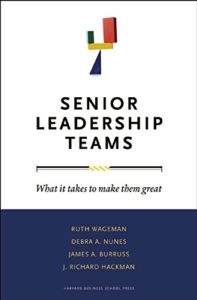
Book review of “Senior Leadership Teams: What it Takes to Make Them Great,” by

Ruth Wageman, Debra A. Munes, James A. Burruss, and J. Richard Hackman


Book cover

In my experience partnering with senior leaders, I often have observed that they don’t focus enough on their team’s shared work, and the team has problems pulling together so the organization advances. It’s crucial that the organization determines when a senior leadership team is needed, and if the answer is yes, for the CEO to pay careful attention to setting up this team.

That’s when you need this high quality, easy to read book with its comprehensive model. For team leaders, the model is actionable; for consultants, it’s easy to work with; and for clients it’s easy to learn. The authors have produced the best book written on the topic of senior leadership effectiveness. First published in 2008, it is a timeless treasure and my “go to” resource when working with senior teams.

This book’s clear, concise model and explanations of how to apply it are an essential resource for senior leaders, consultants, coaches and all leadership teams. The authors’ research into 100 top teams from around the world shows how to craft an effective purpose for your team, staff it with the right people, chose the right structure, sharpen team members’ skills, and get the team support. While focused on senior leaders, I have found the model relevant for all leadership teams.

Here’s a peek into the model:   [Read more…]

6 Clear Steps to Greater Influence: Join Before Differentiating

By Jackie Sherman


Join Before Differentiating

Many years ago I participated in a training for facilitating groups, and my group was working on solving a problem that required us to influence each other. I thought I had a good idea for what we should do, and offered it with direct language. The group, however, continued talking about their own idea. They ignored me. I tried again, but their idea had gained even more steam, and they still ignored me.

After my third attempt, the instructor intervened with a simple but powerful strategy: Join Before Differentiating. [Read more…]

5 Key Steps to Effective Meetings – Making the Most of Your Investment in Meeting

By Jackie Sherman

Meeting

On average, 30-60% of our working time is spent in meetings. A basic building block for working with others, meetings are one of the most frequent ways that we get things done together. Recently several clients asked for my advice about how to improve their meetings. I began writing this post to answer their questions, and discovered just how much I take for granted about designing and facilitating effective meetings. Since this is such a broad topic, this is the first of several posts to help you optimize your investment in meetings.

This is not your usual list of meeting dos and don’ts such as:

  • Have an objective and an agenda
  • Stick to a schedule – Start and end on time
  • Ban personal technology – Ask people to silence their devices
  • Establish ground rules
  • Solicit participation

While important, these are simply “basic meeting hygiene” tips; they don’t set you up for consistently effective meetings. By effective I mean meetings that accomplish their purpose and desired outcomes, and where the participants have had a positive experience and feel that their time and energy were well invested.

The key to holding effective meetings is to use a robust repeatable process, without which your investment is at risk.  Meetings are one of the most basic business processes, and a component of many organizational processes.  Like all business processes, if you design in quality, you are more likely to get a quality outcome.

Right now you may be saying to yourself, “What’s the big deal?  I plan and lead meetings all the time. There’s nothing difficult about this.” I agree that it’s not difficult. But it does take careful planning and consistent attention before, during, and after the meeting.  Now ask yourself, at how many meetings do you hear others remark, “That was a good meeting. We accomplished what we set out to do and we used our time well.”

How Well Do You Plan and Facilitate Meetings?

Take a quick assessment:

For each question below, score yourself using the following scale:
Never = 1
Rarely = 2
Sometimes = 3
Often = 4
Always = 5

  1. When I plan a meeting I start by thinking through the outcomes that are important. “What will be different because we met?”
  2. Before establishing a meeting agenda I understand what other meeting participants think is important to accomplish.
  3. When I plan a meeting I take the time to think through each individual segment of work (the agenda items), who needs to participate in which ways, what time each item might take, and how to facilitate each conversation.
  4. I create a logical flow and put things in an order that allows agenda items to build on each other.
  5. In the meetings I lead we complete all the agenda items.
  6. Participants understand and complete the pre-work needed for the meeting to be effective.
  7. When we start our meetings everyone understands why we’re there and what we need to accomplish; participants are aligned.
  8. For each agenda item we clarify why it’s on the agenda, what we need to accomplish, and how we will do that.
  9. Each participant in the meeting understands their role for each agenda item.
  10. When we need to make a decision, we take the time to clarify the issues, hear each other, and develop options that arise from listening before making a decision.
  11. When making a decision, meeting participants understand their roles and how the decision will be made.
  12. At the end of the meeting, before running out of the room, we review what we did, the next steps, and if/when we plan to meet again.

(Here’s a pdf version of the assessment: Meeting Planning and Facilitation Assessment )

How did you do? If you answered 1= never, 2=rarely, or 3=sometimes to any of these questions, keep reading. You can easily improve the quality of your meetings. If most of your answers were 4 or 5, then congratulations, you are doing the basics well. You may still pick up a few good ideas below.

The 5 Components of Planning and Leading an Effective Meeting 

Once it starts, every meeting has three basic segments – a beginning, a middle, and an end. However, there are two other critical segments – planning before the meeting and follow-up after the meeting. Without a good plan to start with, the meeting itself will take more time than needed and likely not accomplish its goals. And without follow-up much of the work doesn’t actually reach fruition. Sadly, it’s not over when the meeting itself ends.

[Read more…]

Creating the Energy for Change

By Jackie Sherman

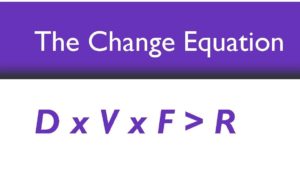
Change Equation for Blog postLike many leaders, you may get ahead of your organization when leading change.  You see what needs to change because it’s part of your role.  However, to lead change successfully, it is critical for you to create an opportunity for others to see what you see … and for you to understand what they see.  

“I’m ready to make change, but my team isn’t.” One of my clients, John, a company president, was clear about the changes he wanted to make but convinced that his leadership team did not want to go with him.  He had assessed the company’s strategy and determined that without change, they wouldn’t achieve the needed business results. When I inquired about the conversations he had with the team, he said, “I shared my ideas for a new strategy, and they weren’t interested.”

I often hear about this type of situation – someone proposes a solution and becomes frustrated when others are not enthusiastically signing up to follow them and implement the proposed change.

As a leader you are always leading change. Your work is to lead your organization from the present into the future … a future that is better than the present. Whether that change is a slow steady progression or requires a significant shift, to be successful you need to generate the energy for the change to be successful.

  • How effective are you at managing change?
  • Do your efforts feel hit or miss?
  • How well do you understand the key factors that lead to successful change?

In this article you will learn a simple yet powerful framework that describes the conditions necessary for change to occur. You can use it to design a change process that flows well from the beginning or to help you understand why a particular change effort is stuck and how to get it moving.

The Algebra of Change:  D x V x F > R

Successful change requires dissatisfaction with the status quo (D), a positive vision for the future (V), and practical first steps (F) to get started. If any of these are missing there will not be enough energy to overcome whatever resistance exists … and there is always resistance.

For change to occur the three variables on the left of the equation are multiplied together. So dissatisfaction, vision, and first steps must all exist (be greater than zero) for the left side to be greater than the resistance, the energy pushing against the change. Ignoring any of them will cause your change to get stuck, take longer, cost more, or fail.

Dissatisfaction (D) with the current state is what pushes or propels a change – it creates motivation. Without dissatisfaction, there is not enough energy for a change process to begin. Dissatisfaction can be directed at something specific in the current situation, or with the current level of results.

No matter how clear the vision and first steps, without dissatisfaction there is no “reason” to change, so you stay stuck.

Vision for the future (V) is the force that pulls the change – it provides direction. It is the positive possibility for the future. Vision must be a compelling description of what you want in the future, not simply the absence of something in the present. Vision needs to be enough of a stretch from what exists today to make it worth an effort to get there, and yet seem achievable. When you have dissatisfaction and first steps, but no vision for the future you create an experience of “change of the month” – trying lots of things, but nothing “sticks” because there is no clear direction.

First Steps (F) are actions you can take to begin the move from the present toward the desired future – a path forward. Clarity about some first steps creates a sense of capability and hope. When you have dissatisfaction and a positive vision for the future, but don’t know what the steps are to get started, you get frustrated and stay stuck. You must have a path forward in order to feel you can get started.

Resistance (R) is a force that slows or stops movement. It represents the risks and barriers to the change – the perceived cost of change. It is normal and natural to encounter resistance – some resistance always exists – it’s part of our biology. Some risks and barriers cannot be changed and others can be influenced to change.

The good news is that you can influence each of these 4 variables. You increase the energy for a specific change by raising the variables on the left-hand side (D, V and F), and / or decreasing the variable on the right-hand side (R).

This framework works for any intentional change – organizational or personal.

Applying the framework for change involving only one person is simpler because there is only one person’s D, V, F and R to consider. Organizational change is more complex because of the greater number of stakeholders involved.

[Read more…]

7 Ways to Know If It’s Time for A New Strategic Plan

By Jackie Sherman

Strategic Planning - a word cloud

What is Strategic Planning? It’s a process of engaging your key stakeholders to agree on the mission, vision, and values of your organization, as well as your goals, and the strategies and key actions to reach them. The result is a plan that focuses the efforts of your organization toward achieving your desired future. To do this you need to know “where you are” and “where you are going.” As the old adage goes … if you don’t know where you want to go, then any plan will get you there.

Every organization whether for-profit or nonprofit, needs a strategic plan. Here are 7 ways to tell if you need to design a plan, or if it’s time to update your existing one.

  1. Your organization has existed for more than 3 years and you’ve never had a strategic plan. When a business or nonprofit starts it has a reason for existing and a sense for its goals, but the immediate start-up needs are often driven by tactical concerns. You get initial funding, put a basic infrastructure in place, develop products or services, and go after initial customers or members. “Long term” is one or two years. But once you are established and have a sense of the lay of the land, you need a more strategic focus to guide you. It’s time for a strategic plan.
  1. The environment within which you are operating has changed. Changes happen all the time: new competitors emerge, customers come and go, the funding landscape alters, the economy fluctuates, or the demand for your services changes. While you need to take notice and adapt continuously, not all of these are reasons to change your direction or strategy. So how do you know when a change in the operating environment is cause for re-examination? When the assumptions upon which you based your plan have changed, it’s time to take a new look.   

[Read more…]

Get Updates

* indicates required

Jackie Sherman

The Jackie Sherman Group is just one part of the equation. We only succeed in partnership with a committed client. Are you ready for success?
Read More…

Read About:

  • ►Client Success Stories
    • ►Organization Effectiveness Consulting
    • ►Nonprofit Consulting
    • ►Meeting Design & Facilitation
    • ►Executive Coaching
  • ►Blog

What Our Clients Say:

Donna Willis

There's something different about the way you're able to relate. It feels more genuine than simply that you're doing a job; while always being exceedingly professional.

Donna Willis
Former Board Chair / Actor's Express

Bruce Carmichael

For 2 1/2 years Jackie provided consulting support to our diversity leadership group and facilitated numerous large and small group interventions thorough our business unit. She is very talented and brings to the table an extensive experience base coupled with a level of insight not found in many consultants. I recommend her highly.

Bruce Carmichael
Human Resources Manager (retired) / BP Corporation

Micah Porter

Coaching with Jackie has helped me in taking a softer, more personal approach to working with clients. She has an ability to listen very closely, not just to the verbal, but also the nonverbal. She knows when to dig deeper and notices what I didn’t see about myself before. She has also helped me become more systematic and consistent as a small business owner.

Micah Porter, CFA, CFP
President and CEO / Minerva Planning Group

Brian Williams

Jackie got me to slow down, which gave me space to think differently. She especially helped me, in my leadership role, work through getting others to collaborate and think through challenges on their own. Jackie creates a good connection, where I can speak freely and feel listened to – it has been valuable for my personal development.

Brian Williams
VP Development / Select Medical Corporation

Marianne Garber – AA

Jackie led us through a strategic planning process that included input from our multi-generational congregation and leadership team, resulting in a dynamic plan that we put immediately into action. The outcome is that we’ve experienced a new level of growth and vibrancy for our congregation. Jackie is highly skilled at working with groups – she was just the right person for this endeavor.

Marianne Garber, PhD
Ahavath Achim Synagogue

Emily Pelton

Jackie facilitated a strategic planning process for our organization that received very positive feedback from our board and donors. I was impressed by her ability to work through the high-level conceptual challenges. And as a leader, I truly appreciated her willingness to ask the hard questions and challenge me to think things through, which always improves the end product.

Emily Pelton
Executive Director / Refugee Family Services

Lara Dorfman

The strategic planning process Jackie facilitated resulted in a plan and structure that has enabled us to better organize our work, broaden our service area, improve fundraising, and engage volunteers – the plan helps us fulfill our mission. Jackie did a great job of managing all of our opinions and passion in an honest, but delicate way.

Lara Dorfman
Executive Director (former) / Jewish Educational Loan Fund

Jeff Alpern

I’m so pleased that, several years after working with Jackie to complete our strategic plan, we are running the organization using the plan as an actionable template. The plan has become embedded into our culture. Jackie’s approach is smart, practical and very thorough. We trusted her process and got the result we wanted.

Jeff Alperin
Board Member / Jewish Educational Loan Fund

Jennifer Bauer-Lyons

Jackie’s coaching has helped me to lead better in what can be an emotionally charged theatre environment. She helps me get to the core issues, deal with the bigger picture, and formulate an action plan. She is very responsive and resourceful and draws from her deep experience in both the for-profit and non-profit worlds, which gives us new perspectives and insights.

Jennifer Bauer-Lyons
Managing Producer (former) / Horizon Theatre Company

Mary Ellen Davis

Jackie has been a coach and strategic thinking partner for me since 2004. She is a great listener and her broad base of knowledge provides an outside perspective to think through problems in ways I can’t do on my own. Jackie helps me come up with processes, is good at showing me my strengths, and she’s helped me add very useful tools to my toolbox.

MED
Executive Director / National Membership Association

Marian McClellan

You can either win or lose during a transition, so it’s important to pay attention to this critical time. The first transition Jackie coached me through was so successful that I have retained her for every work transition for the last 10 years. She helps me get a clear view of the situation and approach it strategically. Her keen observation skills set her apart from everyone else I’ve worked with.

Marian McClellan

Ralph Clements

Jackie helped me 'see' the right questions to ask.

Ralph Clements
VP of Manufacturing and Technology (former) / BP Fabrics and Fibers and Imperial Sugar

Brad Mortimer

We made dramatic progress in 300 days.  I don’t usually praise consultants in public,   but we couldn’t have done this without Jackie Sherman.

Brad Mortimer
Retired President / Propex Fabrics Company

Patrick Prevost

Please accept my sincere thanks for your excellent organisation. It really made it a successful event!  Your dedication and your support to the design team were essential factors in this success.  You managed to keep us on track with the schedule without constraining the group's creativity.  I was positively surprised with the way we were able to engage such a large group and raise all the critical issues.  And it was quite remarkable to see us achieve consensus around a very good list of action items.  A lot of this, was due to your engagement and experience!

Patrick Prevost
Strategy and Development Manager (former) / BP Chemicals

Emily Deakins

Working with Jackie was truly a developmental experience and a real pleasure.  She was able to “get to know me” very quickly, using probing questions and strong listening skills, and then effectively used that knowledge to ask challenging questions throughout the coaching experience, forcing me to look at things differently and explore different options.  She brings a holistic approach to coaching, helping the client discover the connections between different aspects of work and life, and the interdependencies of mental, physical and emotional states.  It is this unique approach, and the resulting new awareness found, which has made a long lasting difference for me.

VP Global Diversity / Fortune 50 Company

Dianne Smith

I have worked with a variety of consultants over the years and have only highest praise for Jackie’s consulting abilities. She worked with a variety of individual and groups during our project. In each of these relationships she met and exceeded our expectations. We would jump at the chance to re-engage Jackie in the future on any organizational change or organizational development project.

Dianne Smith
Director of Human Resources / Emory University General Libraries

Frances Maloy

You helped us with many important changes. Our organization is a different place now. We have greatly improved our communication and decision-making. The 3 years that we worked together were very rewarding for me and rich with learning. I had very challenging times and I could not have made it through without your support. I believe the library has a better result from our reorganization because of your involvement with us.

Frances Maloy
Division Leader and Redesign Project Manager / Emory University General Libraries

K’Lynne Johnson

Since 1999, I've had the pleasure of working with Jackie in multiple roles and scenarios.  Her expertise in effective organization design, change and leadership is unique both because of her truly global, diverse experience base; and because of her deep theoretical knowledge paired with ongoing practical application.

K'Lynne Johnson
CEO (former) / Elevance Renewable Sciences

Morinee Terry

Jackie meets you where you are, works with you to clarify where you want to go, and helps you get there! She has a gift for creating an environment where you can sense her expertise at work without feeling like the latest 'coaching tool' is being pulled out and used on you. Her commitment to excellence, growth, and success has been instrumental in helping me achieve several professional and personal goals.  

Morinee Terry
Human Resources Manager

Pages

  • Home Page
  • About Jackie Sherman
  • Blog
  • Contact

Read About

  • ►Blog
  • ►Client Success Stories
    • ►Executive Coaching
    • ►Meeting Design & Facilitation
    • ►Nonprofit Consulting
    • ►Organization Effectiveness Consulting

Follow Us

  • LinkedIn
  • Twitter

Contact Us

The Jackie Sherman Group
Jackie@jackieshermangroup.com
1608 Bubbling Creek Rd. NE
Atlanta, Georgia 30319
Call: 678-358-4267
Contact Us

Copyright © 2026 The Jackie Sherman Group · New Tricks Web Design